
Podcast
AIM podcast: Building future-ready talent
Hear how Optum India blends AI, agility and empathy to shape future‑ready talent in this AIM podcast episode.
17 April 2026 | 1-minute read and 32-minute watch
Building future‑ready talent with purpose
At Optum India, building the future of health care starts with people.
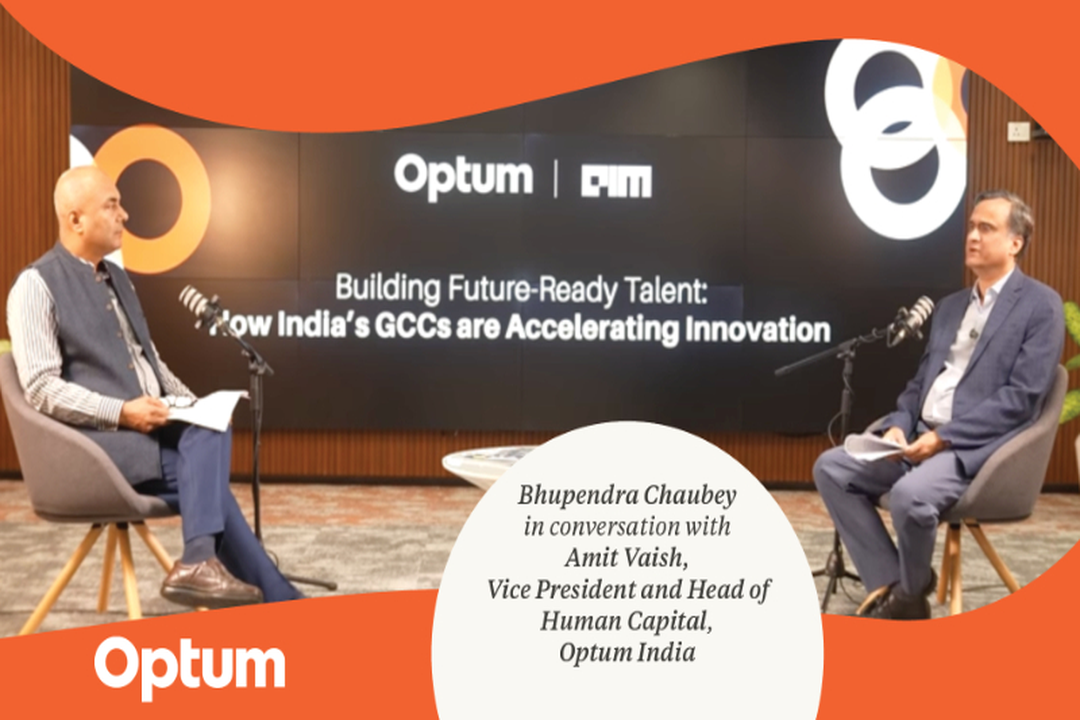
In this episode of the Analytics India Magazine (AIM) podcast, Amit Vaish, Vice President and Head of the People Team at Optum India, joins veteran journalist Bhupender Chaubey to explore how India’s Global Capability Centers (GCCs) are redefining talent strategies to drive innovation at scale.
The conversation goes beyond skills and roles to examine how empathy, agility and continuous learning are becoming critical to creating resilient, future‑ready organizations.
From capability building to culture shaping
Amit shares how Optum India is reimagining talent as an integrated system — combining AI fluency, hybrid clinical‑tech skills and leadership behaviors that enable adaptability and growth.
The discussion highlights the importance of moving from traditional talent models to an always‑on learning ecosystem, where technology is paired with human intent.
It’s a perspective that positions talent not just as a support function, but as a strategic enabler of innovation, helping enterprises translate ideas into sustained, meaningful impact.
We can talk about all the AI in the world. We can talk about all the tech in the world. At the end of the day, it's a
person, it's the individual, it's the human who is at the center of it all. We partner with, you know, uh, some of the
deep techs, you know, to be able to adopt their um, in AI knowledge, you know, all the great AI tools and
platforms for solving variety of business problems in an Indian landscape. How does it work? So, today we have close to about 1.9
million employees. We have almost 120,000 a IML skilled engineers in India
which is massive and that gives I think GCC's in India that edge over their you know global peers. You you celebrate
failure quantity of ideas um is as important as quality of ideas failure.
0:45
Hello and welcome to this special conversation here on this podcast being jointly produced by a IM and optimum.
Well, I'm your host for the show today, Bupendra Chave, and gives me great pleasure to be welcoming Amit VH who's
the vice president and head of people's team at Optimum. But great pleasure for me to be welcoming you today.
Thank you very much. Very excited to be on your show today and share some insights on this very vibrant space of
global capability centers in India. Well, let me before we come to the business end of it, let me just first
understand a bit about you yourself, right? I mean, you're the you're the head of people's team. So what does this
head of people's team really do? Let's just break that down first. Yeah. So we call our human resources
team the people team and you know for a reason that you know we directly partner with all our stakeholders. You know we
impact our people experience uh positively. Uh that's you know our effort. Um but in reality you know this
is the human resources team that um u you know has a very wide uh spectrum of
uh different functional areas that uh we operate in um you know to attract retain and develop talent for our businesses.
So how many people how I'm trying to understand in your individual way in your indiv from your individual lens how
many people in your company would actually be getting impacted by the decisions that you take. So we have a very large workforce in India bupin
that's uh distributed across all of the major centers for GCC's in India and uh
we've been operating as a global capability center for United Health Group for more than two decades now uh
in India and all of our employees are engaged in delivering technology and
operations services of different kinds across the entire healthcare value chain. So that's really what we do from
here and we're also the innovation hub for United Health Group. That that's quite exciting. You know this this global capacity center, right?
Is it what is it? What what does a global capacity center really do? Is it u is it just a business entity? Is it a
conglomerate of people coming together to service a completely different end of the continent in an Indian landscape?
How does it work? So global capability centers are basically in-house centers, right? and they've gone through their own journey of evolution in India which is a story
that's uh very widely known. Essentially these are in-house centers now termed global capability centers that partner
closely you know with their enterprise businesses on transformation priorities which could be pretty diverse. I think
what's very impressive u you know bupendra for information of everyone is
uh the growth trajectory that these uh centers have been on you know for the last several years and that is truly
truly impressive you know when you look at u the evolution the maturity and the scale that um these GCCs have acquired
you know in the last several years that's a success story that is pretty wellnown out there but um you know it's
not just everything that's happened in the past but more importantly uh the growth opportunities that await
them you know in the future that are really going to uh impact talent strategies of the future you know which
is relevant uh for what I do and what my function does uh and also position GCC's
uh for more innovation orientation uh in the future like what no just to share with you you know some
ex yeah I'll build on that just to share with you some numbers and you know this is all out there um in the public domain
so today we have close to about 1.9 million employees um you know of different um professional domains that
work in GCC's. This number is expected to increase to about 3 and a half 4 million by 2030. We have almost 120,000
a IML skilled engineers in India which is massive and that gives I think GCC's in India that edge over their you know
global peers because they can draw on this talent pool to fuel their innovation strategies you know for the
future and as um GCC's invest more in upskilling talent more graduates come
out of engineering colleges this number will only grow in the future almost 2025 GCC's are getting set up every quarter
and they don't necessarily have to go through you know the same learning curve that GCCs of the first generation about
20 years back had to you know go through. Also I think very interestingly um the number of roles that are truly
global meaning they come with global ownership and accountability is expected to increase to about 30,000 by 2030 and
that is huge we're talking about. So I think with these shifts that we are seeing you know in the GCC landscape in
India there are a set of talent priorities that GCC's in my view should be thinking about you know for the
future. Now what are these to your question? I think first of all um looking at building product management
capabilities right so historically global capability centers have had large armies of operators and technologists um
you know in their uh centers if you embed and colllocate product management
capabilities alongside them I think it has the potential to unlock tremendous value uh for the enterprise in the
future. Secondly, I think leveraging the broader innovation ecosystem to the
advantage of the enterprise. So by partnering with startups that you have across the board in India, partnering
with leading academic institutions and also offering opportunities for your internal talent pool to share their
innovative ideas can actually unleash innovation in a very significant way that can be quite disruptive to
addressing business challenges you know of the enterprise. Then you have what's the kind of you know just on that
what what's the kind of skill sets that we're talking about in these GCCs that you're looking at. Yeah. So I think the skill sets are
pretty diverse you know it could range from in the context of healthcare right that we find ourselves um in India with
respect to optimum's diversified footprint um it could range from software engineers you know it could
mean um a IML capabilities today it could mean cloud engineers it could mean
resiliency engineers it could mean um um you know data scientists data architects
and the likes. So you have a pretty complex tech stack that we operate in to deliver solutions you know to our
businesses. Uh in the space of operations you have medical coders you know you have um uh people who deliver
processes you know you have um uh customer servicesvicing uh professionals you know who are directly indirectly
supporting um you know customer outreaches. uh you have finance
professionals uh you know you have uh uh people who deliver operational excellence transformation program
managers so and above all you know you have uh very deeply skilled and experienced highc caliber leadership
right that sets a direction for our uh global capability centers in India you know at the end of the day uh whe
whether you're you're an entity which is only catering to the Indian markets or overseas markets ultimately at the end of the day I would like to believe that
any global uh capability enter the fundamental premise has to be on innovation. How are you promoting
innovation? So let me ask you in in your position of the leadership role that you
have in your organization, what are the steps that you take which enhances which
fosters the spirit of innovation? Yeah, that's a great question and I think um the like I mentioned at the start I
think in the context to global capability centers their success in the future to a large extent will you know
hinge on how they can bring innovation to the forefront right you know going
beyond delivering cost efficiencies or productivity it's about really how you can bring innovation to um the problems
that you are you know working on and there are several you know steps that we take as far as optimum India is concerned to be able to harness harness
innovation potential of our employees of course our large workforce but equally going out there to partner in meaningful
ways with the ecosystem to bring innovation you know to our businesses. So we have you know um lots of our teams
are working very closely with uh players in the healthcare space that we've identified uh to look at operational
efficiency solutions that are on the back of AI very interesting products that they have you know incubated that
have the potential of bringing in fresh ideas for addressing pressing business problems um you know for healthcare we
run an annual innovation event every year uh which is called IFA and that actually uh has been successfully
running for a couple of cycles now where we actually crowdsource ideas you know
from teams of employees of your own company or is it of our company of of our company right people get together form teams uh cross
functionally which means you know oper operations talent you know partnering with the technologist partnering with
you know some other capabilities to get together to look at innovative solutions
around business problems that u you know they're interested with and uh through a process proess of selection through
funneling of ideas we eventually get to the top 10 you know that we actually host on a grand finale and that gets I
think a lot of attention that has gone on extremely well with our stakeholders with our employees
can you can you give us an example in terms of how like let's say one of these 10 instances that you're looking at which went on to the grand finale one
such example which germinates at the very root in your company uh and comes up through the ladder and
goes up straight to the finale and is then implemented which then fosters a spirit of innovation that you speak.
Sure. Sure. So there was um uh you know a solution that I recall which our
learning team for example they um uh cracked and you know they were interested to look at how you can
upskill in a certain you know technical capability how they can upskill a particular team uh in uh processes u in
a particular healthcare domain and they went about you know transforming that
approach to delivering the learning solution from something that was very manually intensive earlier that was more
in-person based and took a long time it was inefficient to something that was now more AI enabled on the back of a
learning platform that is more AI enabled it gives the learners the ability to personalize the learning at
the pace and the you know time that suits them best and that I think has
made a tremendous impact. It has reduced cost. It has improved the learner experience and it has impacted learning
outcomes pretty positively. Right? So that was an automated solution which this learning team created. And in in your experience, you know,
something like this that you're talking about this learning experience, how does it inspire? Yeah. You know, the rest of your workforce?
Sure. I mean, you're such a big company as you're speaking about, right? If one such person's idea ends up going right
at the top and is mentored, supported by the company to someone who may be just joining the company, what kind of an
inspirational role does it play? Yeah, I think it's when the whole ecosystem comes together is when you actually um
you know get people inspired around the value of innovation and how they can be
on their journey itself. So while the idea that I spoke about and there are literally hundreds of more such ideas
across the company, it's about how we put the spotlight on the particular idea, how the leadership actually talks
about it and you know shares the value and impact at the very highest level of those ideas. how um they prioritize this
right as far as the business is concerned and how they enable employees
give them the tools resources the funding that is really required you know to seed ideas scale them up grow them
fail fast you know it's very importantly I you know I must talk about that not all ideas succeed but that's okay I mean
it's and we you know communicate that quite openly to our employees as well and tell them that it's absolutely fine
you know to fail learn from it and then you know move on uh to um you know the
next successful leg of your innovation journey over there. So it's not let's say again from an
Indian lens you know it won't mean that because you fail it leads to some punitive steps against you.
Absolutely not. I think we constantly tell our employees that look coming up with ideas is vitally important. Failure
is only a stepping stone right towards learning from it and then moving on um to um um you know something that will be
more successful next time around. And the best ideas we've had have always gone through starts and stops. They've
never been linear you know in their progression. Uh they've required the constant support and guidance ofmemes of
leaders of stakeholders who provided various inputs to be able to perfect it and then eventually you know they it
gets rolled out at scale. So we don't you know um look at failure um in a
negative light. uh we talk about it, we encourage it and uh you know uh we we uh
celebrate it as well, you know, to to help people understand that it's okay. You you celebrate failure. Yeah. Sure. How how does that happen?
I we we are learning from it. I mean, I'm not I'm not saying that we do it. Uh Sure. Sure. Sure. I mean, you you look
at it in the positive way. Yeah. We we have lots of leaders I think you know in the innovation contest and others who have very openly shared their
own vulnerabilities, right? They tried to do something, it didn't work, but that's okay. I mean you know their
sponsors their mentors their coaches uh encourage them you know to uh get up and
u you know uh make a better impact next time around. So by talking about it openly coming from leaders themselves uh
people draw comfort and inspiration that it's okay. So it's not like sport you know like if you look at sport you look at cricket
for instance right which is great passion. It's almost as if if you fail once or twice your team your position in
the team ends up being threatened or if you give too many ideas you know to your superiors that can again in Indian lens
can sometimes be looked against. That's not what what happens here. Yeah. No I I think we are one team u you
know we are guided by one mission. That's why you're head of the people's team. That's right. So you know we we uh want
people to be upskilling themselves. We want people to get new ideas and at this
point in time quantity of ideas um is as important as quality of ideas. It only
then can you actually harness an innovation culture that you know we want them to. So more is better for us and we
are constantly um you know wanting people to u join that journey towards
becoming uh innovationdriven organization. you know Amit your you guys are your your company the kind of
people everything about you is big in terms of scalability in terms of your innovation but when you're big you know
it also brings the burden of greater responsibility on you right how do you
ensure that in these times and there's so much of AI there's deep tech there's there's so many intrusions right all around us in this space of health tech
from the vantage position that you occupy in your company how do you ensure safety yeah it's a great question um um and uh
one that uh you know we have learned bupin by trial and error. We are still learning. I don't think any organization
today that I look around has claimed victory as far as adoption and scaling up of AI is concerned. They're all at
various stages in their journey. I think for me and you know for for our
organization it's about really understanding the lay of the land in healthare system. Healthcare is an extremely complex space as I as I've
mentioned and by that virtue of its complexity, it is also a very interesting use case for the responsible
application of AI and AI has many uses right to be able to address chronic
challenges in healthcare around making healthcare more affordable uh removing
friction in the system improving customer experience for the benefit of all. We are a missiondriven organization
and we are tasked to improve the health care system for everyone that uh healthcare impacts.
But just help me understand this. You know, I'm listening to you and I'm asking myself this question that AI deep
tech which I'd like to believe you know are our great friends uh and and great complements to your ecosystem. But do
you really look at them as as enablers? Are they enabling you to do better business? Oh, absolutely. I mean we have
or is is that leading to some newer challenge for you for which you still have to grapple for answers? Well, the challenge well let me answer that in two
parts, right? The the the one is the opportunity of partnership. I think we partner with you know uh some of the
deep techs you know to be able to adopt their um in AI knowledge their platforms
and tools which you know we've offered uh our to our workforce to help them uh
upskill themselves, reskill themselves and make use of you know all the great AI tools and platforms for solving
tech themselves and several other GCC. The challenge is one of uh change challenge is one of enabling progressive
culture shifts right and that very naturally as a global leader in healthcare uh which is committed to
using AI responsibly for transforming healthcare. we are acutely aware of. We know that you know the rapid adoption of
uh AI and its scaling will not come without its challenges in terms of managing change for the large workforce
and to your point the scale that at which we operate in and how are we doing that in a couple of different ways.
First of all addressing any apprehensions or fears that our workforce will have. Right? We have invested heavily in upskilling everybody
across the board. So for technology for example it means completing certain certification courses that are important
for them to become skilled at uh usage of AI. For others it is about going through again you know courses that are
nontechnical including leaders themselves who must understand what it means to be an AI first leader today.
And for everybody regardless of the role you play the function you are in it is about using AI tools right only then can
the adoption be institutionalized across the organization there. Now it is also
about trying to emphasize to everybody today that uh we don't need to use AI as
yet another tool for automation and efficiency of which we have plenty but using the power of AI to really
reimagine processes right and that is what will solve those challenges in healthcare that I talked about of
wastage of duplication of inefficiency and ultimately help us to impact the health system more positive
but the one word which I which I've heard extensively from you is leadership right uh you know you've thrown some
light on how you're upskilling uh your own labor force by the kind of instances that you're giving. But I'm just
thinking does it not add to your challenge because technology also evolves and changes at a very very rapid
pace. What are the kind of steps that that you take at least within your organization at your level which ensures
that your workforce is up to speed with the most advanced or or developed
technologies which are around us in this space. So let I mean the uh investment that we are making as I mentioned in
upskilling our workforce uh in AI but in other areas as well right I spoke about AI let me talk about US healthcare
systems for example right that is one of the most important determinants uh of
how we can continue to evolve and become even more strategic in our partnership
with the enterprise going forward as I mentioned we've been in India for more than two decades now and we've acquired
great scale we have deeply differentiated healthcare domain capabilities out here. We are well
distributed uh and we've been successful in several ways but that's the past right now. The future will greatly
depend on how successfully we can continue to deepen our understanding of US healthare systems and that's a
complex space because US healthcare is dependent on several moving parts right governmental policies regulations
technology changes and the likes and therefore keeping pace you know with that is vitally important for us to um
stay ahead of the curve. We partner with several specialized uh partners who have an understanding of that to upscale our
workforce on US healthare systems. Incidentally uh I must share with you Pendo that upskilling our uh employees
on US healthcare also has a profound impact of developing empathy across the
board right which is extremely important for success uh in our healthare system. How does that happen? Upskilling people
to deal with US workforce leading to empathy across the board. Totally. because the US healthare system is plagued with you know several
challenges right members expect better experience uh they find cost of healthare um prohibitive healthare is
not always accessible you know at places that people want it to be and there are several breakages in the system that
don't necessarily lead to a positive experience on the part of that there are several stories I can quote from our
front lines where an employee in India for example has proactively scheduled a
member appointment when the member himself probably forgot to do that and that very simple act of scheduling that
appointment with a care provider you know on that day ensured that the member
you know was around to see a healthy life for several years after that it's a small example probably an insignificant
one in the context of the large healthare system but that comes only with empathy it doesn't come with performing a role like
someone else you know would do in a GCC in India so at the end of it then therefore it's interesting that you say this because
then that what that brings us to is that we can talk about all the AI in the world. Yeah, we can talk about all the tech in the
world. At the end of the day, it's that basic human connect. It's that basic
person on the ground. It's a person, it's the individual, it's the human who is at the center of it all. Is that the
spirit by which you're guided? 100%. I mean 100%. It's technology. We've always said technology is not at the center.
The the person who's at the center is the member who needs care, right? the patient who approaches care delivery
organizations at times when they are most vulnerable and I think dealing with them with compassion with empathy is
what our workforce is all about. Let's let's let's look at the leadership position that we were talking about. You
know, how do you you know, how do you ensure that you stay ahead of the curve? Is it just by upskilling? Is it by
generating the spirit of empathy that you're speaking about? What are those criterians, those essential ingredients
you feel which keeps you ahead of the curve on the leadership? Yeah, great question. And I couldn't agree more with you that leadership
underscores success in more ways than anything else there. Right. uh unfortunately the reality
what is success is it financial success is it human success for us success is about delivering on
our mission which is to transform health care for the system as a whole right and you know we are deeply committed to the
pursuit of doing it and there are clear indicators that we are making progress in the right direction of course there's much more to do and we are committed to
progressing on that journey now as far as leadership is concerned the reality
is that unfortunately today's times there isn't a playbook right that leaders can readily use uh to um you
know adopt styles of leadership that are proven to be successful etc. It's you know each person aspiring to become a
leader and successful in their own right must evolve their own playbook depending on the context that they find themselves
in. For us at Optum, our belief is that we are one team guided by one mission,
one mission and we embrace one culture that is grounded in our core values over there. And this brings a set of
leadership behaviors that are integral for the success of all our leaders across the broad enterprise. So there
are very clear you know behaviors in line with our core values like being bold which results in better innovation
right connecting and growing that develops relationships right um you know being u responsible in the use of
technology um you know also um acting honorably right which directly impacts
our core value of integrity and others that u leaders are actively uh
encouraged you know to adopt in their ways of working And that I think underscores um successful leaders
leadership for us. But let me ask you, you know, when you're bold, yeah, you can often end up being brash as
well, right? And it's a very very thin line. How do you ensure that your your workforce at least doesn't drop?
So, so this is I was wanting to complete actually that and you know for us all of these leadership behaviors are important
to ground us in the culture that we aspire to build and for us it's not just about what we do but how we do that's
equally important. Right? So I think that you know hopefully answers the question around you know you can you can
be bold but you can also be brash but not necessarily if you know you also uh
give a thought to how you're approaching you know your deliverables and your KPIs and your hard targets besides just uh
you know the the what of uh no I I I'll tell you what I'm getting at you know again to give you a sporting example right there is Sachin Dendulkar
who's a god of cricket and then there is Virat Kohli who's a king of cricket right Sachin Dendulkar stands for
certain values equally big brand. Virat Kohli stands for certain values, equally big brand, but one is very bold, very aggressive.
One is very bold but brash. Both of them great leaders in their own right. Right. So I'm trying to understand how does how
does a big company like you with the scale of workforce that you have with your ability to impact human lives that
you clearly seem to be impacting. How do you ensure that the scale is always tilted in favor of being bold, being
aggressive but being good? Is it that human value? Is that human connect that you focus on? It's entirely that I I think like I've said
previously as well. We um we are a large enterprise, a fortune
3 organization, global leader in healthcare services and benefits. Uh we have you know a great deal of uh
expertise in uh solving healthcare problems that no one else you know uh in
the world can do. We are uniquely positioned as because of our size, scale, um, and, um, experience to be
able to do this. Um, and we pride ourselves at at doing, you know, solving some of the most complex healthcare
problems. But at the same time, we approach, you know, our solution with a
profound sense of compassion, with a sense of empathy for the person who needs care the most. And I think when
you combine the two, right, when you combine that rigor of developing the best-in-class solution with the empathy
that is required to apply it actually to the person who needs it most in their times of vulnerability is when actually
you get that persona of care delivery that uh really delivers impact. You know the other the other challenge I
find again for big businesses is is with with large workforces is often the
distinction between human capital and financial capital. at your level, how do you ensure again if empathy and and
human human connect is at the core of your organization, how do you ensure that when it comes to balance sheets
also, it's not just the financial balance sheet that you're looking at. It's not either or. It's not that if you you know focus on human capital, it is
at the cost of financial capital or the other way around there. End of the day, you know, this is a large commercial
organization. Everything that we do with respect to people is with a financial outcome as well, right? You know whether
it is going out to the market to hire best-in-class talent, whether it is retaining our top performers, whether it
is investing in growing them to take on more progressive responsibilities or whether it is like I said uh shaping
future ready skills like artificial intelligence or medical coding or you know process excellence or something
else all that you know all of these are very very directly aligned you know to financial outcomes of our business that
are priority for you know for them and we don't lose sight of the big future when we actually look at you know
managing our human capital goals you know since I've since I've come here and I've been interacting with the
employees I find that a number of them have been working here for well over 10 years would would I you seem to be the
amongst the young a lot of of that group what is it I mean help me understand the culture what is it that this
organization does what's at the heart of the culture that people are seem to be happy being here
yeah no true very true and um I would attribute it to I Think just the fact
that we are able to connect the work we do you know every single employee and they're constantly reinforced by
messaging through leadership by messaging through team manager you're not a hierarchical organization sorry
are you not a hierarchical organization at all we are a large organization but I won't call us hierarchical because we you know
our leadership is very very approachable uh you know we work pretty much hands-on
across the rank and file of the organization it's all sleeves rolled up you know we get down to addressing
challenges at whatever level required to do so. So it's not just hierarchy you know in the traditional sense of it.
Yeah of course we have roles and we have you know all of that stuff but typically our leaders are you know very grounded
in the work they do. They you know go and work right at the front lines to look at you know customer challenges or
any process problems that are required to be solved and they deal with the fires that are important. Tell tell me
tell me about one story which gives you the greatest amount of satisfaction. You know did you manage to save a human life
like you were telling me about this example of for someone who may have forgotten his appointment something that
when you went back home you thought yeah you know I mean this is this is a great place to be in I've done I've done the best thing in my life. Yeah. So I'll
tell you the story recently and uh you know uh it's it's relevant to the work that I do in u uh HR. We organized an
event um uh couple of months back in Bangalore with our visiting u you know
global technology leader and this was an event um that was targeted to u engage
with prospective AI talent right we were looking to hire them um and we did a you
know typical event over there to bring them on for the day it was an event for a couple of hours over lunch or so and
you know in the leadup eventually to the engagement uh with them. Uh there were
some talks and there was a panel discussion as well that was um being hosted for the information of all these
prospective you know talents that we were chasing uh to help them understand what exactly we
did with you know all the AI capabilities that we are trying to build internally for addressing healthcare
challenges and uh in the course of I think that event um many of those who
were present on that day were so mesmerized that I think um towards the end of the event when we were just
having a networking session with the leaders one of them walked up to me and said that look um I've heard you know
every company using AI to solve business problems but Optimum is probably the only company that is applying AI to make
a difference to human lives and I think that for me was a moment of reckoning because coming from somebody who had no
connect with the organization whatsoever and you know leaving us with that perspective at the end of that
engagement session It meant a lot. So in conclusion, Amit, you know, to all the people who'd be watching this this
broadcast, whether it's leadership or people who' be entering the profession, let me ask you what would be that one
piece of critical advice that you'd given at least at least to your juniors, you know, we operate as I said in in
times of great technology and great intrusion and all that one advice,
you know, which could keep people on the positive side of this balance sheet that I was talking about financial capital versus human. is about being guided by
our mission and that's what we take great pride in Bukindra. We are an organization that is in it not just for
the commercial success of our enterprise which is of course important uh given the you know position that we occupy um
in u you know the industry but it is equally about staying true to our mission of transforming health care for
the greater good right for all stakeholders who are impacted by the health system and I think when you
connect your work with that larger purpose is when you derive pride in it when you will get people to stay here for the long term as you know you've
noticed So that would be my advice as well to to think about how your work really impacts I think that purpose uh
of ours as an enterprise that I think will keep them u engaged for the long term. Well AIT we live in times where shelf
life of everything appears to be getting shorter and shorter. Great pleasure for us to be in conversation with you and to
hear all these insights from you. Thank you so much. Thank you very much. It's been a pleasure.
Creating a healthier world together
Related healthcare insights

Article
This platform fosters impactful conversations and drives solutions for a more flexible, progressive healthcare ecosystem.

Article
From AI to virtual reality, technology is transforming healthcare, and these 5 skills are becoming critical.


White paper
For our 2-part series on the future of AI, we surveyed more than 100 healthcare leaders. Part 1 reveals how leaders are approaching AI investments. Part 2 looks at the leadership challenge that executives face.