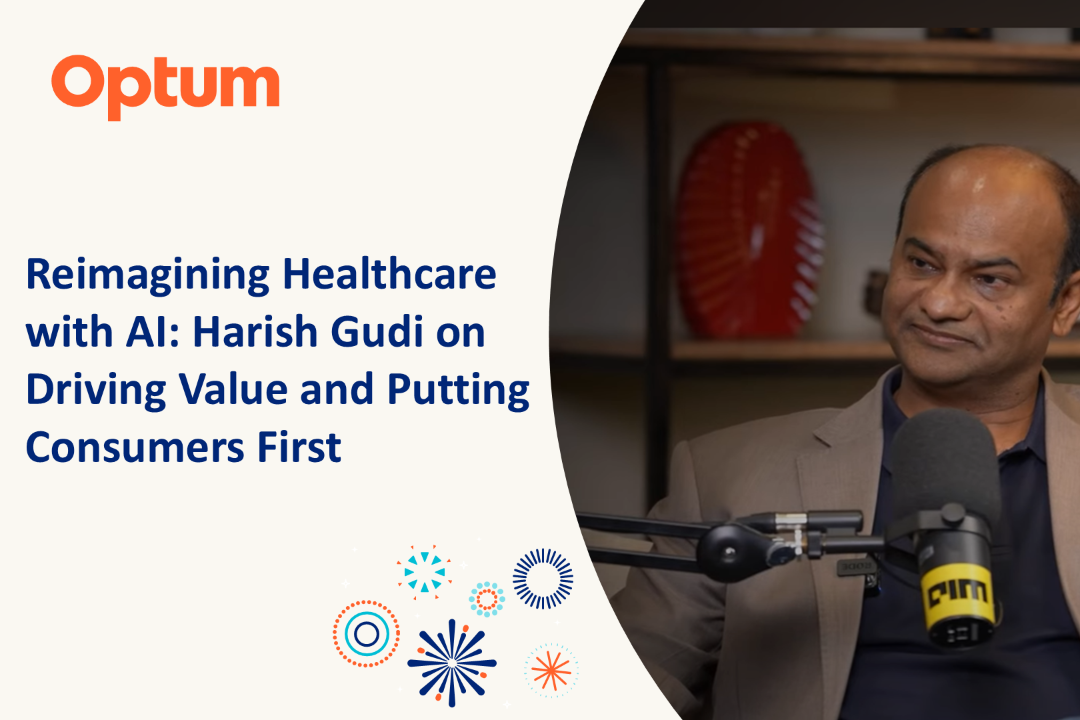
Introduction
0:00
I have with me Harish Guri, CIO of Optum
0:03
India. According to you, what do you
0:05
think is happening in the whole health.
0:07
tech sector?
0:08
There is better care, there is better.
0:10
procedures available today but more
0:12
expensive
0:14
as a technologist with the kind of
0:16
innovations that's happening. Which one
0:18
Are you most excited about that can
0:21
bring a big shift in the whole
0:22
healthcare industry? I think there are
0:25
three things that are really exciting me
0:28
and are going to make a difference to
0:30
affordability, access and outcome.
0:33
Number one,
0:34
so Harish, there's a lot of discussion
0:36
on value based.
0:37
Yeah.
0:38
Uh can you first tell us what that is
0:40
and what is the shift from episodic
0:42
care to value based care?
0:44
It's a big shift that is happening in
0:45
the industry. Like we talked earlier, if
0:48
you look at healthcare costs as a
0:50
percentage of GDP in the country, I
0:52
think it's rapidly rising. You know the
0:55
question is how we manage that better
0:59
with better outcomes?
1:01
Tell me how you think AI is
1:03
transforming healthcare industry?
1:05
If there is a job that AI should
1:08
do and will do, healthcare is probably
1:11
the most consequential job that AI will
1:14
do.
The state of healthcare & key challenges
1:15
[Music]
1:22
Welcome to a fresh episode of simulated
1:24
reality podcast by AIM leaders council.
1:27
I'm Vanda Naya and I have with me Harish
1:30
Guri CIO of Optum India. Thank you
1:33
Harish for taking the time to speak to
1:35
us.
1:35
Vana it's a pleasure to be here with
1:37
you. So Harish let's begin with uh I
1:40
want to understand the whole market now
1:42
with the healthcare industry rapidly
1:44
changing you have a lot of market
1:46
dynamics which is changing uh customer
1:48
perceptions which are changing so
1:51
according to you what do you think is
1:53
happening in the whole health tech
1:55
sector
1:56
look from a shift perspective there is a
2:00
rapid change in the ecosystem in
2:02
healthcare that is happening and uh I
2:06
would say there are three main
2:08
challenges in the industry as we see in
2:10
the United States u also in many places
2:14
and many other countries the challenges
2:16
tend to be similar in the US here is
2:18
what we're seeing we are seeing
2:20
challenges in and around how we make
2:23
cost of healthcare lower which is all
2:26
about affordability
2:28
number two how do we make access to
2:31
health care easier so we call that
2:34
access and last but the not the least
2:37
How do we focus on quality of outcome of
2:40
healthcare?
2:42
The challenge is not just about meeting
2:44
these demands or needs individually.
2:48
It's about how do we do all three of
2:50
them together. Right? That's the
2:52
difficult part. Now, if you look at uh
2:55
affordability, what's really happening
2:57
is the cost of healthcare in the US
3:00
is u rising at a pace that is faster
3:04
than inflation. Number one. Number two,
3:07
there are better more modern medicines
3:11
available today but more expensive.
3:14
There is better care. There is better
3:16
procedures available today but also more
3:19
expensive.
3:21
If we do not manage the situation well,
3:23
the cost of healthcare is to shoot up is
3:26
going to shoot up beyond being
3:27
affordable to all the people who
3:30
actually need the care. So that is
3:32
challenge number one.
3:33
Let's talk about accessibility.
3:37
No matter which part of the world you
3:38
go, US included access to care in the
3:42
most remote part of the country or
3:45
locations,
3:47
when needed continues to be the big
3:50
challenge and how do we solve for that,
3:52
right? That's a big one. Last but not
3:56
the least, how do we shift from
4:00
care being about sporadic
4:04
treatment when an event or an episode
4:06
happens versus ensuring that we take
4:11
care of health in such a way that the
4:13
outcome the overall outcome is better
4:16
and it not just about episodic
4:17
intervention
4:19
like I said it's about getting all these
4:21
three together and solving for them
4:22
together
4:24
in the In the middle of all these two
4:25
more things to remember. One
4:28
lots of administrative procedural
4:32
process overheads in the system. How do
4:35
we reduce administrative burden? So if
4:37
I'm burdened with administrative
4:40
overheads, my focus on you as a
4:44
consumer, as a patient goes down, right?
4:46
And I think this is what has to come
4:48
together
4:51
in an overarching theme where it
4:55
continues to be human centric
4:58
and human making the decisions. That's
5:01
the name of the game.
5:03
All right. That that sounds interesting.
5:05
And as a technologist with the kind of
5:08
innovations that's happening, which one
5:10
are you most excited about like that can
5:12
bring a big shift in the whole
5:14
healthcare industry? But then as a
5:16
technologist I'm excited about
5:18
everything. But if I were to look at u
5:22
healthcare in particular I think there
5:24
are three things that are really
5:27
exciting me and are going to make a
5:29
difference to affordability, access and
5:32
outcome. Number one, I think there is a
5:36
sea shift happening in the mind frame
5:40
and mindset
5:41
of this person not being a patient but a
5:45
consumer. What that means is when you
5:48
start thinking of your patient, your
5:52
provider also and put them in the center
5:55
of the universe as a consumer.
5:56
Yeah. and you uh implement technology
6:00
surround with technology surround with
6:03
innovation surround with care and
6:04
surround with outcome it changes the
6:07
game. So I'm very excited about
6:10
consumer experience centric
6:12
solutions right uh whether it is uh find
6:16
enterprise care whether it is apartment
6:18
scheduling whether it is providing the
6:21
right level
6:23
and uh you know verified information
6:25
about conditions looking up nutrition
6:28
looking up diet and all of these become
6:31
very important from a consumer
6:33
experience perspective. Number two, I
6:37
think along with consumer as a center,
What is value-based care?
6:41
there is a shift towards focus on
6:44
wellness, right? With all the
6:47
information that is available today with
6:49
focus on nutrition, diet, well-being,
6:53
exercise, let's talk technology, IoT,
6:58
devices that can tell you how, you know,
7:00
your health is progressing. Bringing all
7:03
that together to be able to predict a
7:06
need before it arises really
7:10
excites me. Right now last but not the
7:13
least a lot of these are built on a
7:16
foundation of a digital platform. So
7:20
what excites me is
7:22
the journey of building a core digital
7:25
platform that enables
7:28
data interoperability
7:31
with consent of course to be able to
7:34
create those innovations that we are
7:35
talking about at the edges innovation
7:38
happens at the edges of data at the
7:40
edges of system and that's why
7:42
interoperability is very big these three
7:45
things
7:46
I think are going to make the change
7:48
happen in the industry So Har there's a
7:50
lot of discussion on value based care.
7:51
Yeah.
7:52
Uh can you first tell us what that is
7:54
and what is the shift from episodic
7:57
sorry episodic care to value based care?
7:59
Okay. So let me um say this in like
8:02
simple terms.
8:04
Sure.
8:04
What is value based care about? It is
8:06
about shifting from
8:09
volume to value. Number one, it is
8:13
shifting from fee for service model,
8:16
right? To a quality of outcome based
8:20
model, right? Let me explain
8:23
this from the patient consumer
8:25
perspective. Let me give you an insight
8:27
from a you know caregiver provider
8:30
perspective and also from the insurance
8:33
provider payer perspective. Right? From
8:35
a uh patient consumer perspective,
8:39
what value based care does is that it
8:43
focuses on your outcome, your well-being
8:46
and able to put together all the
8:48
information that you need to be able to
8:51
create better affordability and better
8:53
accessibility and better outcome for you
8:56
as a consumer, as a patient. From a care
9:00
provider perspective,
9:02
physician provider, nurse, it makes sure
9:06
that it puts together the data and makes
9:09
it easily available. reduces
9:11
administrative overhead and ensures that
9:15
resources,
9:17
staff, amenities, hospital beds,
9:20
everything that is available is
9:22
optimized and used in such a way that
9:25
care can be better and more people can
9:28
be taken care of in a more timely
9:29
manner.
9:30
More importantly,
9:32
the shift from
9:35
what you said
9:36
from you know just treating that
9:38
situation or condition that happened to
9:40
be a to be able to prompt
9:43
about keeping the patient well or
9:47
healthier
9:48
and what are those things that we can do
9:51
right it gives and empowers the
9:53
physician nurses with that ammunition
9:55
and information to be able to make the
9:57
right decision from a payer perspective
10:00
it's all about that that dollar the
10:02
every dollar how far can I take that
10:05
dollar and make every dollar count in
10:08
terms of access to care and in terms of
10:10
affordability. When you solve these
10:13
three things, what happens is the entire
10:15
health care system which is VBC moves
10:18
from an episode based
10:21
treatment paradigm
10:24
to a wellness-based prevention based
10:27
paradigm which changes overall quality
10:31
and outcome of health.
10:32
And this shift is what is happening
10:34
now, right? If the focus is more on
10:36
that,
10:36
it's a big shift that is happening in
10:38
industry. Like we talked earlier, if you
10:40
look at healthcare costs as a percentage
10:42
of GDP in the country, I think it's
10:45
rapidly rising.
10:46
U now the question is how do we manage
10:50
that better with better outcomes.
10:54
So Harish uh let's talk about the most
10:56
important thing AI. Uh now we're seeing
10:58
how AI is transforming a lot of
11:00
industries and healthcare is no
11:02
exception. uh from say diagnostic
11:04
accuracy streamlining administrative
11:06
process and a lot of things. So can you
11:09
throw some light on how this is
11:11
happening in healthcare and also if
11:13
possible where are the AI use cases that
11:15
are there in United Health Group and
11:17
Optimum?
11:18
Look uh AI is making
11:22
access to data analytics
11:26
predictive analytics predictive modeling
11:30
everything more seamless. NLP is
11:32
creating wonders, right? Because of all
11:35
this, we are able to bring together vast
11:38
amounts of data and be able to analyze
11:41
them like whether it is uh EHR data,
11:45
wellness data, variable data, social
11:48
determinants of health. How do we bring
11:50
it all together to be able to do like a
11:54
predictive
11:55
kind of modeling in scenarios? I think
11:57
that's what uh AI is doing to the
12:00
industry.
12:02
From a use cases perspective, um there
12:05
is uh more than 100 use cases that we
12:07
have at Optum.
12:09
But more importantly,
12:11
what we have first is a well defined
12:15
and clear structure
12:17
on
12:18
use of data, which is responsible use of
12:21
data and responsible use of AI. In
12:24
healthcare, everything has to be
AI use cases in healthcare
12:26
explainable, right? So AI doesn't make
12:29
the decision for you. It gives you
12:31
enough information so that the care
12:34
provider human in the middle right can
12:38
make the decision. I think that's very
12:40
important. Now let's uh look at uh use
12:43
cases right if you look at uh the
12:46
customer centricity right from a
12:48
customer's perspective many use
12:51
cases that help you find care price care
12:56
u make appointments automate follow-ups
13:01
and all kinds of use cases that are
13:03
available from a consumer perspective
13:06
from a provider perspective we're able
13:09
to bring together all the data that
13:10
I talked about which is EHR, social
13:13
determinants of health and put it all
13:14
together
13:16
to be able to give a care plan which is
13:20
a best practice so this AI can learn
13:23
from best practices create a best
13:25
practice plan and make that available a
13:27
predictive plan available to the care
13:30
provider who are able to make well
13:32
informed decisions so that's on the care
13:35
side there is also a lot of work
13:38
happening on the administrative side uh
13:41
removing administrative steps,
13:43
procedural steps using AI. There's a lot
13:46
of uh communication that goes out,
13:48
right? Communications uh AI is able to
13:51
automate. Uh many times they are in
13:53
dozens and dozens of languages, right?
13:56
So there's a bunch of um you know
13:58
clinical help use cases and a large
14:01
bunch of administrative operational
14:04
efficiency use cases that are available
14:06
in AI that we are working on also. know
14:09
uh public health trends right AI can
14:13
predict monitor public health trends it
14:16
can uh be watchful and predict outbreaks
14:20
that are happening it can predict uh and
14:23
give us signals on vaccines that will be
14:26
required
14:27
that helps optimize the entire system
14:30
right vaccine is not just about it being
14:32
there when you go it's about you know
14:34
the manufacturing process the shipping
14:36
process and everything that goes behind
14:39
the scenes to get that vaccine there on
14:41
time.
14:42
So the earlier you can predict these
14:44
kind of things the better you can
14:46
service the consumer and AI is helping
14:48
with all of that today. Harish coming to
14:50
the end of this I have a question for
14:53
the future like so now technologists to
14:56
adapt to the evolving healthcare
14:58
ecosystem that's happening what kind of
15:00
skills and qualities do you think they
15:02
should be having to kind of match the
15:04
scale of evolution that's happening
15:06
so if they're technologists they're
15:09
already great at technology
15:12
the one thing that they now bring need
15:14
to bring to the table in this healthcare
15:16
e ecosystem is to bring
15:19
people process technology together with
15:23
like I said consumer in the center. When
15:26
you bring all of this together that is
15:28
when magic can happen by bringing the
15:30
power of AI, bringing the power of
15:32
digital and bringing the power of zero
15:35
distance. What do I mean by that? I mean
15:39
don't sit in some cubicle somewhere and
15:41
think of some new healthcare app that is
15:44
going to make a difference. It's not
15:45
going to happen like that. You have to
15:47
be able to bring all these elements
15:49
together which means you have to be zero
15:51
distance from the consumer. Develop your
15:54
solution zero distance from the
15:55
consumer,
15:57
zero distance from the care provider,
16:00
zero distance from the advocate who is
16:02
also helping the consumers. If you
16:05
develop your AI, your digital
16:08
interventions, your platform with this
16:10
in mind, following all the clear
16:12
structured methods and guidelines that
16:14
the organization provides for you, I
16:17
think you can make a hell of a
16:18
difference. I think we are at the cusp
16:21
of making magic to be able to make the
16:24
healthcare system work better for
16:26
everyone.
16:28
All right. Great. Yeah. So, thank you so
16:30
much, Harish. Uh, this was truly
16:31
insightful. Thank you for your time.
16:33
Thank you Vina. It was a pleasure and
16:35
hope to see you see you sometime
16:36
again soon. Thanks.
All
Watched